Insulating Your Florida Home for a Cooler, Greener House
Air sealing and attic insulation save about 15% on cooling costs. Here is the R-value target for Orlando and the Space Coast, the best materials and what rebates still exist.

Key takeaways
- 01EPA estimates air sealing plus attic insulation saves about 15% on heating and cooling costs.
- 02Orlando and the Space Coast are in climate zone 2, where the attic target is R49 (R38 if 3 to 4 inches exist).
- 03Air conditioning is about 27% of household energy spending in the hot-humid Southeast, so attic heat is the enemy.
- 04The federal 25C insulation credit ended for work completed after December 31, 2025; utility rebates remain.
- 05NAR and NARI estimate an insulation upgrade recovers about 100% of its cost at resale.
Attic insulation and air sealing are the highest-return efficiency projects for a Central Florida home. The EPA estimates that sealing air leaks and adding insulation in attics and other accessible spaces saves about 15% on heating and cooling costs, or about 11% of a home's total energy bill (ENERGY STAR).
In our climate that savings comes almost entirely from the air conditioner, which runs nine or ten months a year. Most of Orlando and the Space Coast sits in climate zone 2, where ENERGY STAR's target for an uninsulated attic is R49, and R38 when a few inches already exist (ENERGY STAR R-value guide). Many older homes here have less than half that.
Why insulation matters more in Florida than almost anywhere
Air conditioning is the single largest line on a Florida power bill. In the hot-humid Southeast, air conditioning accounts for about 27% of household energy spending, and 94% of households run it, compared with about 12% of energy spending nationally (U.S. Energy Information Administration, 2015 RECS data). Every degree of heat that gets through your roof deck and ceiling has to be removed by that system.
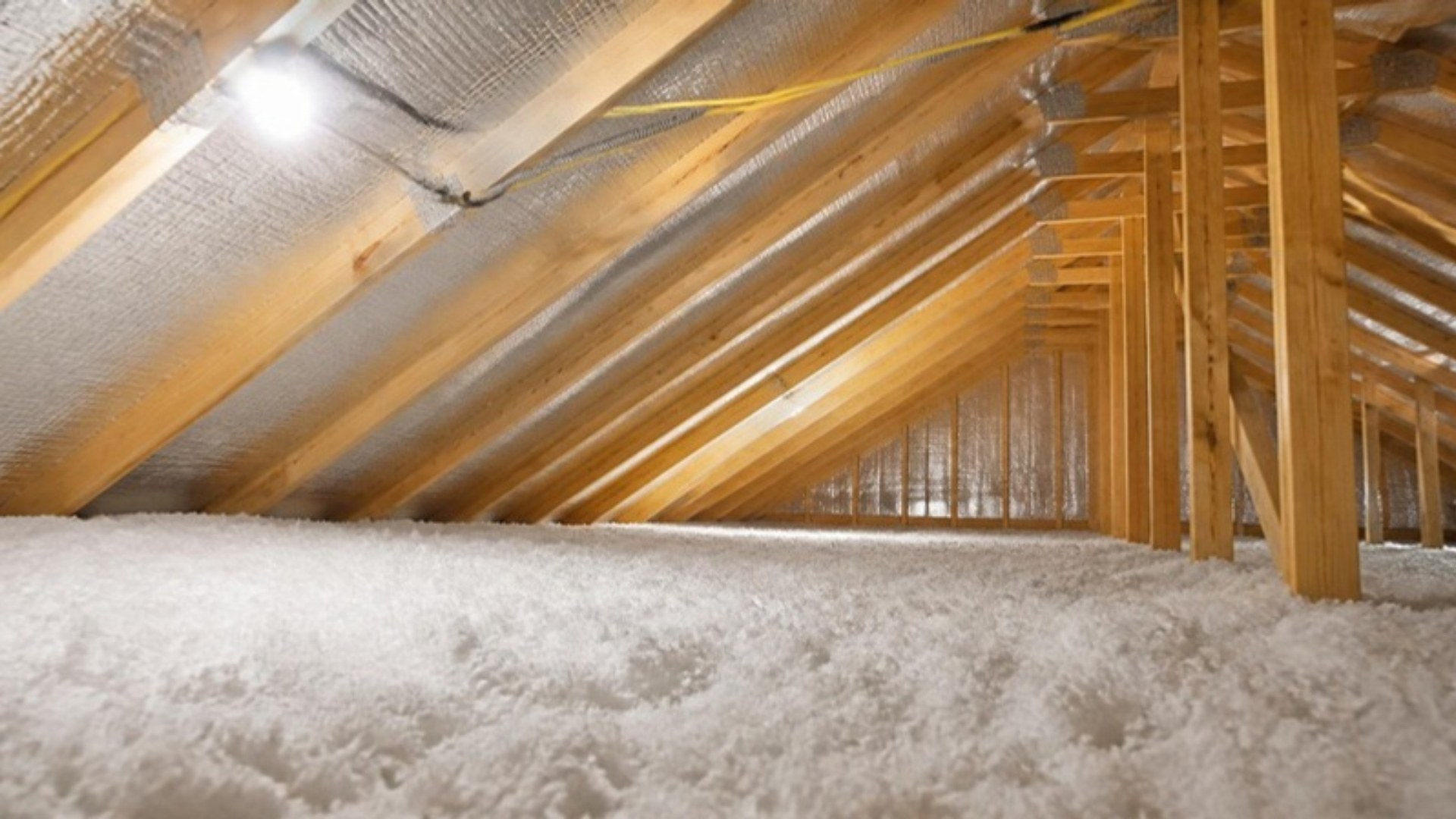
A Florida attic in August can run well above the outdoor temperature. Without an adequate blanket of insulation on the attic floor, that heat radiates straight into the rooms below, and the thermostat responds by running the compressor longer. Insulation does not cool the house. It slows the heat down so your equipment can keep up, which means shorter run times, lower bills and a longer life for the air handler.
How much attic insulation does a Central Florida home need?
ENERGY STAR publishes recommended attic R-values by climate zone. Florida spans zones 1 and 2, with South Florida in zone 1 and Orange, Seminole, Osceola and Brevard counties in zone 2.
| Climate zone | Uninsulated attic | Attic with 3 to 4 inches |
|---|---|---|
| Zone 1 (South Florida) | R30 | R25 |
| Zone 2 (Orlando, Space Coast) | R49 | R38 |
Source: ENERGY STAR recommended home insulation R-values.
The quick check is to look across the attic from the hatch. If you can see the tops of the ceiling joists, the insulation is below R30 and a top-up will pay. If the joists are buried and the insulation is level and dry, you are closer to the target and your money is better spent on air sealing and ductwork.
Which insulation types work best here
The original version of this article listed four materials. All four still make sense, but the right choice depends on whether your air handler and ducts live in the attic, which is the case in most Central Florida homes.
| Type | Best use here | What to know |
|---|---|---|
| Blown fiberglass | Topping up an existing attic floor | Recyclable, low cost, easy to add in layers |
| Blown cellulose | Attic floors in older homes | Made mostly from recycled paper, treated for fire and pests, fills gaps well |
| Open-cell spray foam | Sealing the underside of the roof deck | Brings ducts into the conditioned space, needs a licensed installer and attention to ventilation |
| Recycled denim batts | Walls and sound control | Safe to handle, strong soundproofing, higher price per R |
Spray foam on the roof deck deserves a note. Sealing the attic moves your ducts and air handler out of a 130-degree space and into a conditioned one, which is why builders use it on most new homes in Orlando and Viera. On an existing home it is the most expensive option, it changes how the attic ventilates, and it should only be done by a contractor who understands Florida moisture behavior. For most resale homes, a cellulose or fiberglass top-up to R38 plus thorough air sealing delivers most of the benefit at a fraction of the cost.
Key point: Insulation only works when air is not moving through it. Seal the attic hatch, plumbing penetrations, recessed lights and top plates first, then add the blanket on top.
The rest of the system: sealing, ducts, roof and thermostat
Air sealing comes first because leaks move humid outdoor air into the house, and humidity is what makes a Florida home feel warm at 76 degrees. Caulk and foam the gaps around pipes, wiring and the attic access, and weatherstrip the hatch.
Ducts are the second target. Leaky supply ducts in a hot attic push cooled air into the attic and pull attic air into the house. A duct leakage test from an HVAC contractor is inexpensive and often finds the biggest single loss in an older home. A light-colored or reflective roof, a radiant barrier stapled to the rafters and a smart thermostat set to a schedule round out the package. None of them replaces insulation, but each one reduces the load the insulation has to handle.
Rebates and tax credits as of October 2026
The federal Energy Efficient Home Improvement Credit, which covered 30% of insulation and air sealing costs up to a $1,200 annual cap, applies only to improvements made through December 31, 2025 (IRS). Work completed in 2026 does not qualify, so do not count on a federal credit when you price the job.
Utility programs are the remaining source of help. OUC, Duke Energy Florida and FPL each run residential efficiency programs that change year to year, and some include ceiling insulation or duct repair incentives. Check your utility's current program page before you sign a contract, and ask the installer to document the before-and-after R-value, which you will want for the next section.
What this means in Orlando and on the Space Coast
Buyers in both markets have choices, and operating cost is now part of the comparison. Orlando had a 4.9-month supply of homes in August 2026 with an average of 64 days on market (Orlando Regional Realtor Association), and Brevard County single-family homes sat at a 3.5-month supply in July 2026 (Space Coast Association of Realtors). A documented insulation upgrade is a concrete answer to the "what are the power bills?" question that comes up at nearly every showing.
The housing stock makes the upgrade more valuable here. A large share of homes in Winter Park, College Park, Merritt Island, Cocoa Beach and Satellite Beach were built between 1955 and 1985, before current attic insulation standards, and many have never been topped up. The National Association of Realtors and NARI have estimated that an insulation upgrade recovers roughly 100% of its cost at resale (NAR, 2022 Remodeling Impact Report), which makes it one of the few improvements that lowers your bills while you live there and returns its cost when you sell. If you are weighing it against other projects, see our ranking of remodeling projects by resale value, and if a sale is on the horizon, our sellers page explains how we document upgrades for buyers.
Next step
If you are not sure where your attic stands, start with the joist test and a utility bill from last August. If you are planning to sell within a couple of years, find out what your home is worth today so you can judge whether an insulation upgrade is a comfort decision or a resale decision. In Central Florida it is usually both.
Frequently asked questions
What R-value should attic insulation be in Orlando or Brevard County?
How much can insulation save on a Florida power bill?
Is there still a federal tax credit for insulation in 2026?
Is spray foam worth it on an existing Florida home?
See what your upgraded home is worth today
Get an instant valuation, then decide whether your next project is for comfort, for resale or both.
Don Harkins
Broker / Owner, Don Harkins Realty
Don is the broker and owner of Don Harkins Realty, a boutique Central Florida brokerage that sells homes in an average of 16 days at 100.7% of list price. He also originates residential mortgages through Don Harkins Mortgage (NMLS #1700560) and oversees Sea Dog Property Management. FL Broker BK3251280.